
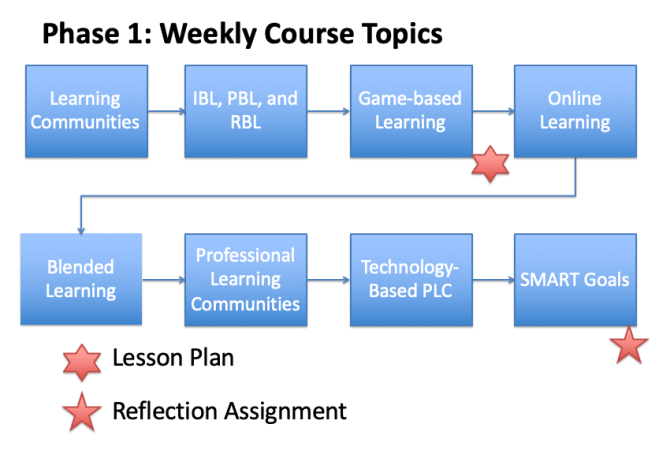


The research team aimed to develop and implement a single course intervention that would drive teachers toward encouraging student engagement through or within games that moved beyond testing memorization of content. To achieve this, the phase 2 intervention needed three key affordances:
- The intervention needed to allow them to all have a shared experience and common language in order to share ideas with one another and recognize the value of games for collaborative learning. It seemed necessary to provide an intervention that would appeal to all teachers, no matter what grade or subject they teach.
- The intervention needed to allow them to consider how collaborative learning with games could be integrated in their own lesson plans. Often educators have a hard time imagining what instruction they have not themselves experienced might look like, so experiential learning activities are often used in teacher training (Kolb, 2014). The intervention was intended to be a model of what collaboration could look like beyond the typical answer a kahoot question and talk with a partner type of instructional model demonstrated in many of the Phase 1 lesson plans.
- The activity needed to provide an opportunity to reflect on why collaboration within the context of the game might be important for developing a shared understanding of content for students. Further, the intervention needed to allow for the teachers to begin developing a way of thinking about the connection between the parts of the game that supported interactions, parts of the games that did not afford purposeful interactions and the work the teachers would need to do in order to foster collaboration towards supporting students learning of specific content

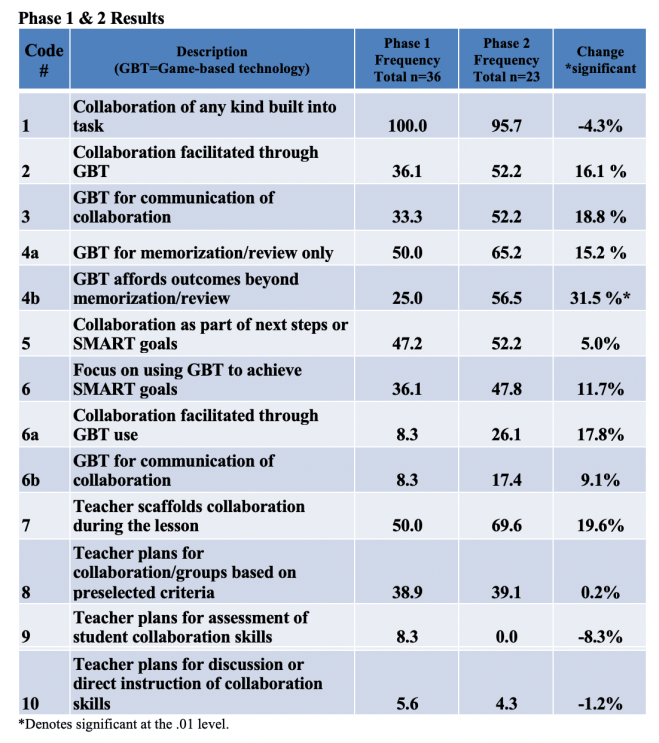
The phase 2 results showed one statistical change from phase 1. This was a 31.5% gain in the use of technology that went beyond simple memorization tasks. This suggest that teachers in the phase 2 group included the use of games-based technologies that allowed their students to engage with the content of the lesson in ways that went beyond simple recall or memorization processes. This was a primary goal of the second intervention, and a statistically significant result suggest the instructional intervention achieved at least some of the research teams’ vision for transforming teachers work.
Further phase 2 results also included a number of important gains, that while not statistically significant, indicated movement in the positive direction for the desired outcomes including a 18.8% gain in teachers using the game-based technology for communication of collaboration, a 17.8% gain in teachers planning for collaboration that is facilitated through the technology and a 19.6% gain in teachers explicitly building in scaffolds for collaboration during the lesson.
While these positive gains suggest movement towards teachers using game-based collaboration instructional approaches that were better aligned with course goals, the results also suggest room for further improvement. While the statically significant improvement on code 4b is positive, nearly half of the teachers were still using technology for simple memorization or review based tasks. This high percentage, combined with limited to no movement in teacher planning for preplanning collaboration or considering collaboration as part of their SMART goal formation, suggest that the impact of the intervention was limited in the scope of overall teachers’ ability to implement collaborative learning experiences using game-based technologies.
 aaron m. kessler